
Right Now, AI is the Worst it Will Ever Be
Why the way you’re thinking about AI capabilities today is already outdated – Agentic AI development is changing the game.
There’s a phrase that keeps rolling around in my head, and once you hear it, you can’t unhear it: “AI is the worst it will ever be right now.”
Think about that for a second.
Every complaint you have about AI’s limitations today, every “it’s not quite good enough for that” or “it can’t really do this yet,” all of that is already on its way to being obsolete.
Not in five years. Not even in one year. In months. Sometimes in a few weeks.
At any given moment, it’s the worst it’ll ever be, and that’s the saying I keep in my head all the time.
Working at Rōnin, I’ve spent the last few months watching this transformation happen in real-time. But what I’m seeing isn’t just incremental improvement; it’s a change in how software gets built.
The growing divide between code assistants and Agentic AI development
A clear line is forming in the development community, and I can spot it immediately in how people talk about AI.
On one side, developers still describe AI development as a “code assistance tool,” something that helps them write code faster, suggests completions, and catches bugs. They’re saying things like “I’ll try that eventually” or “I don’t think it’s ready to be used for production code.”
On the other: developers who’ve fully embraced agentic coding. They’re no longer writing code at all. They’re architecting, validating, guiding. The AI models are creating the actual code, and they’re reviewing the output.
You can tell the difference between the people who are leaning into agentic coding and those who still think of it like 2025 (or even early January of 2026, as crazy as that sounds).
Why evaluating AI based on today’s capabilities is a strategic mistake
Here’s where most companies and developers are getting wrong: they’re evaluating AI based on what it can do right this minute.
If a business leader tries an AI tool in January and finds it lacking for their specific use case, they might file it away as “not ready yet.” But by March, that same tool will have doubled its capabilities. By June, it’s doing things that felt impossible in January.
If you’re thinking about how AI is right this minute, you’re thinking about it wrong. You need to think about how AI will look in six months or a year and plan and adjust accordingly.
I know it’s overused, but everyone I know loves that hockey metaphor about skating to where the puck is going. But the truth is that most people aren’t doing it. They’re not skating to where the puck is going; they’re skating to where the puck was last month. It’s the same with AI. You need to move forward and stop looking back.
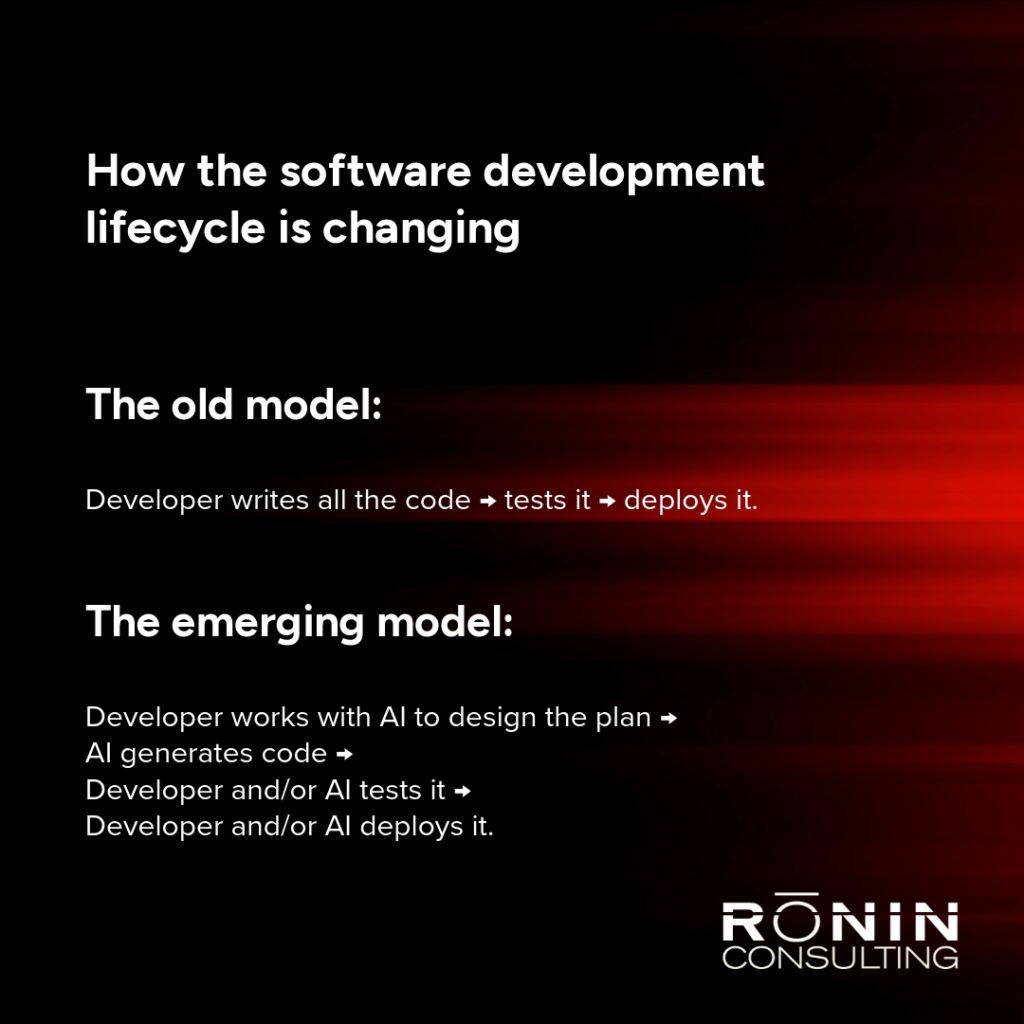
How Agentic AI is changing modern software development
At Rōnin, we’re not waiting to see how this plays out. We’re actively experimenting with restructuring our entire software development process to align with where AI is heading, not where it is today.
The old model: Developer writes all the code → tests it → deploys it
The emerging model: Developer works with AI to design the plan → AI generates code → developer and/or AI tests it → developer and/or AI deploys it
We still need developers with real-world technical experience who can work with the business, understand requirements, develop an architecture, and guide the AI in its planning. But in more and more cases, that doesn’t mean that person needs to write any of that code anymore. It’s more of an oversight role.
Does this work for every scenario? Not yet.
Highly regulated industries, some government work, systems with strict governance requirements, they’re not quite ready for this shift. But they’re getting there faster than anyone expected.
The unpleasant truth: this is going to ruffle some feathers
I can’t sugarcoat what’s going on right now, and the truth is that some developers aren’t going to like this future.
Honestly, I get it. Byron McClain (my Rōnin co-founder) and I have worked together for years. If you put a few pieces of code in front of me and asked me to guess which one he wrote, I could point it out in a second based on his variable naming patterns alone. I know his coding style. I can see his fingerprint in the logic.
Unfortunately, that level of fingerprinting will change.
We are shifting to a place where coders will no longer write code. It will be someone telling the machine, “Here’s what I want it to be, here are my ideas, here is the architectural vision,” and then validating the machine did it.
For many developers who are used to getting their dopamine hits from writing that perfect piece of logic, from seeing their code compile cleanly, from the craftsmanship of it all, this new change might feel like a loss.
However, I don’t think you should view it that way. If anything, I encourage those developers to lean in and implement features they previously couldn’t create due to deadlines or cost constraints. A lot more creative approaches and complex solutions will be possible now, where they just weren’t before.
Don’t panic: how business leaders should adapt to Agentic AI now
If you’re a business leader trying to figure out your AI strategy, here’s my advice:
Stop evaluating AI based on today. That AI assessment is outdated before you finish writing it. Look at the trajectory. Where was this technology three months ago? Where is it now? Where will it be in six months? Look ahead.
Start experimenting now. The learning curve isn’t getting any shorter, but the capabilities are accelerating. The gap between “trying it out” and “falling behind” is measured in weeks or months, not years.
Focus on architecture and validation, not implementation. The future advantage isn’t in having people who can write code the fastest. It’s in having people who can design the right solutions and validate that AI-generated code meets requirements.
Expect disruption in your vendor relationships. Those massive enterprise software contracts might start looking very different when you can build custom solutions at a fraction of the cost and time. Do you really need all that software?
Because here’s how I see it: AI is the worst it will ever be right now.
Which means it’s already darn good.
And by the time you finish reading this article, it’s gotten even better.

Recent Posts
-
 Why Domain Knowledge Is Critical for AI-Driven Development
 -
 Once a Rōnin, Always a Rōnin. A Conversation with Software Developer Austin O’Byrne
 -
 What an AI-First Feature Build Looks Like From the Inside
 -
 AI and Compliance: Why Regulated Industries Are Falling Behind
 -
 Al Fresco Coding: Building a March Madness App with AI