Al Fresco Coding: Building a March Madness App with AI
Every year at Rōnin, we do Crazy Eights, a March Madness side game where you pick eight teams, root for the underdogs, and watch most of your picks flame out by Friday afternoon.
For years, it lived in a spreadsheet maintained by one of our developers. He would copy in the seeds, manually update the wins, and post the results to the group chat. It wasn’t hard, but it took some time to update.
But this year, with the internal push to vibe code with Claude, we thought — why not save some time and vibe code an app for it?
So we did.
A little history (and a borrowed spreadsheet)
Crazy Eights didn’t start at Rōnin. It can be traced back to some earlier days of our developers, when a friend introduced the game and built the spreadsheet. Over the years, the spreadsheet has moved and grown, only to find its home at Rōnin in 2017.
The genius of Crazy Eights is its accessibility. You don’t have to care about college basketball to play. You just pick eight teams, ideally some mid-seeds who might pull off a Cinderella run, and hope for chaos. You’re looking for that 5-to-12 range, teams that are good enough to win a couple of rounds but low-ranked enough to actually earn you points when they do.
Anyone can join in Crazy Eights, just pick your 8, and you’re ready – but internally, someone must manage each person’s 8 picks, update the scores, and manually do the work on their own. Updating and managing all the scores was time-consuming, and there had to be a better way, right?
Enzo Aquino sure thought so.
The “I forgot all about it” moment
Enzo Aquino, partner and software architect at Ronin, had promised to build an app for this year’s Crazy Eights. He wanted to build something the whole team could use, rather than waiting for spreadsheet updates in the group chat. He had every intention of building it before March Madness started.
And then he went to Italy.
He was mid-vacation, somewhere between the Colosseum and a pasta-making class, when he realized that the March Madness tournament was starting a week sooner than he thought.
“I forgot,” recalls Enzo, “I was like, I promised to do this. I gotta do this.”
So, he did what any self-respecting developer on vacation does: he opened his laptop, fired up Claude, and got to work.

From the first prompt to deployment on Azure, it took him roughly two hours, an espresso and a few pastries to complete.
How Enzo vibe-coded his App with AI
Enzo will be the first to tell you he’s not a frontend guy. But that didn’t matter.
He pointed Claude at the Rōnin website, told it to pull the color scheme and design language, described how the game worked, and let it build. His strategy, one he swears by, is to nail the design up front so it stays consistent all the way through.
Fix it later,” Enzo says, “and you’ll always miss something.”
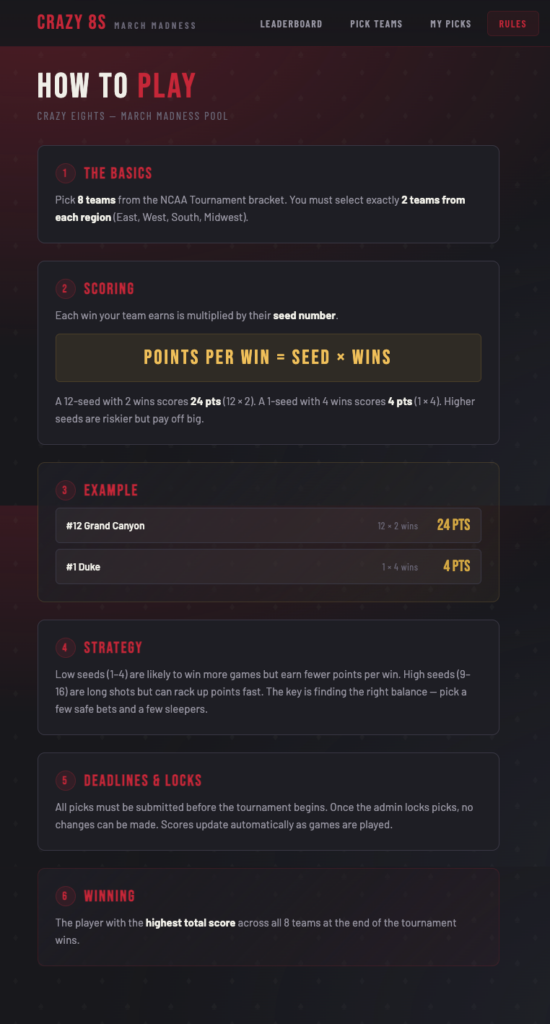
The result is a clean, fully functional web app where the whole team can submit their picks, track standings, and watch the carnage unfold in real time. You can check it out here: (should we share it – or just show photos)?
But like so many development projects, there was a hiccup. Enzo was pulling live game data from ESPN, but ESPN quietly changed its data structure mid-tournament. And that type of bug, which may have taken a while to find or fix, took him only 20 minutes.
The app was then posted to Rōnin’s internal GitHub repository with all the artifacts and deployment scripts, so technically anyone on the team could have pulled it down and asked Claude to patch it themselves. It was that easy.
Using AI to build an app is all about experimenting
Here’s the thing about a two-hour app built from a patio chair in Rome: it’s not really about the app.
It’s about what happens when a developer who “doesn’t do frontend” decides to try anyway, because the barrier to just building the thing has gotten low enough that it no longer matters.
Enzo has seen both sides of using AI in projects.
He has seen some clients that are nimble and ready to move fast, and others where adoption is a slow, heavily regulated crawl. The contrast couldn’t be starker. For nimble companies, you can spin up an app on vacation in 2 hours. For the other kind, you’re waiting months just to get access to a model that might already be two years old.
Vibe coding with Claude is all about experimenting. Trying something, seeing what it does, and building from there. That mindset comes naturally when there are no guardrails slowing you down. But it’s also exactly the kind of proof-of-concept thinking that can light a fire under the companies that are still waiting on the sidelines.
That contrast is the story of where many companies are right now. The technology is there. The results are real. But getting an enterprise company that is heavily regulated to change direction takes time, and in the meantime, the developers who can use these tools are lapping everyone else.
Enzo’s Crazy Eights app is a small, goofy, totally unnecessary thing that made the whole team’s March Madness experience better.
But it’s also proof of something bigger: that when you remove the friction, people can build with AI, and they can do it fast.
Want More Content Like This?
Join the Rōnin Recap
Get expert insights on AI, integration, and the future of software — direct from the team at Rōnin Consulting. We’ll send you the good stuff, not spam.